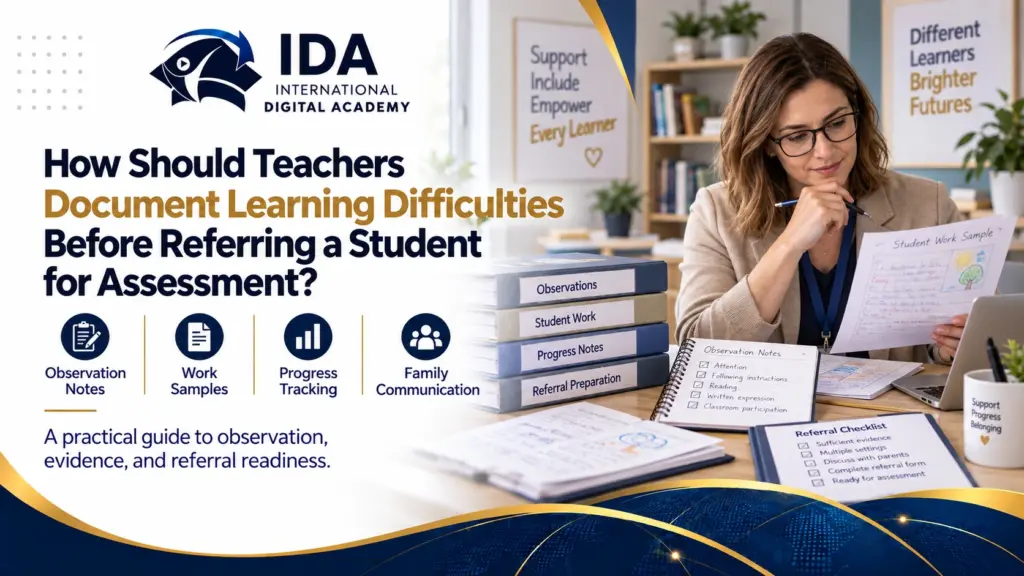
Teachers should document observable learning patterns, not diagnose a learning disorder. Before referring a learner for assessment, record the task, the evidence visible in the learner’s work, the support already tried, and how performance changes over time. For teachers in Morocco, this creates a clearer basis for discussion with the family, the school team, and any qualified professional involved in assessment while keeping the teacher within an educational—not diagnostic—role.
A learner who struggles once does not automatically have a learning difficulty. The pattern may relate to unclear instruction, limited prior learning opportunities, language development, attendance, emotional stress, sensory needs, task design, or another factor. Instead, careful documentation helps the school move from impressions to evidence without placing an early label on the student.

What is classroom documentation—and what is it not?
Classroom documentation is a structured record of observable performance. It describes what happened, in which task, under what conditions, and with what support. However, it is not a medical or psychological diagnosis, and it should not assign a disorder based on one test, one lesson, or one teacher’s impression.
Formal assessment and diagnosis depend on local procedures and the professionals authorized to conduct them. In Morocco, as elsewhere, referral pathways can differ between public schools, private institutions, support centers, and healthcare services. Therefore, teachers should follow the procedure adopted by their institution and communicate within the limits of their professional role.
What should a teacher record before making a referral?
1. The task and learning expectation
First, establish the context. Record the subject, skill, instructions, materials, time allowed, and expected level of performance. “The student is weak in reading” is too broad. “During a grade-level oral reading task, the student omitted word endings and needed repeated prompts to continue” is more useful.
2. Observable performance
Next, describe actions that another professional could recognize. Note errors, pauses, strategies, level of independence, accuracy, task completion, and the kind of help required. At the same time, avoid character judgments such as lazy, careless, or unmotivated.
3. Work samples from more than one occasion
Keep dated examples of relevant work when institutional policy permits. For example, one sample can reflect fatigue, misunderstanding, or an unusually difficult task. By contrast, several comparable samples reveal whether the pattern is persistent, improving, or linked to a particular context.
4. The support already provided
Then, record the instructional adjustment used: shorter instructions, modeling, guided practice, visual support, additional time, smaller steps, peer support, or a change in task format. In turn, documentation becomes more informative when it shows not only the difficulty but also how the learner responded to support.
5. Progress over time
Next, use simple, repeated checks rather than waiting for a final exam. The Institute of Education Sciences notes that no single assessment provides everything educators need for sound instructional decisions and recommends drawing on multiple sources, including classroom work and routinely collected assessment data.
6. Student and family perspectives
Finally, ask the learner what feels difficult and which strategies help. Communicate with the family using neutral language and invite relevant information about previous schooling, language use, health or sensory concerns, major changes, and learning conditions at home. Above all, do not present an unconfirmed diagnosis.
Use this simple observation cycle
- Define the concern: name the specific skill or classroom task.
- Collect a baseline: record current performance with a dated example.
- Try a focused support: change one or two relevant instructional conditions.
- Monitor the response: repeat a comparable task over an agreed period.
- Review with the school team: decide whether to continue support, adjust teaching, or begin the institution’s referral process.
Importantly, this is not a universal legal sequence. It is a practical classroom framework that must be adapted to the learner’s age, the concern, school policy, and available support services.
What does an evidence-based observation note look like?
| Instead of writing | Write observable evidence |
|---|---|
| “He never understands mathematics.” | “In three two-step word problems, he selected the correct operation after the teacher underlined the key information, but could not select it independently.” |
| “She is careless when writing.” | “Across three dated writing samples, she omitted spaces between words and reversed the same letters despite copying from a visible model.” |
| “The student does not concentrate.” | “During a 15-minute independent task, the student began after two prompts, worked for three minutes, and resumed when the task was divided into two shorter steps.” |
In short, good notes are specific, dated, proportionate, and respectful. They document the learning situation rather than define the learner by the difficulty.
How can teachers avoid confusing a learning difficulty with another factor?
Before making a referral, consider alternative explanations without trying to rule them out alone. Review attendance, access to prior instruction, clarity of teaching, task difficulty, language of instruction, vision or hearing concerns, emotional circumstances, and whether the difficulty appears across subjects and settings.
In particular, this is important for multilingual learners. An Institute of Education Sciences review on English learners and learning disabilities emphasizes the value of multiple forms of data, pre-referral strategies, family involvement, progress monitoring, and attention to language, culture, previous schooling, and classroom context. Moreover, the same principle is relevant beyond English: difficulty using the language of instruction should not automatically be treated as evidence of a learning disorder.
When should a teacher raise the concern with the school team?
For instance, a discussion is appropriate when the difficulty is persistent, appears across repeated comparable tasks, limits access to learning, or continues despite relevant classroom support. Immediate escalation may be required when there is a safety, safeguarding, sensory, medical, or serious developmental concern, according to institutional procedures.
Ultimately, the teacher’s role is to contribute clear educational evidence. The school team can then use that evidence to decide what additional support, screening, specialist consultation, or formal assessment is appropriate.
How should the concern be discussed with the family?
- Begin with the learner’s strengths and successful conditions.
- Describe observable examples instead of using labels.
- Next, explain which supports have already been tried.
- Ask what the family observes in other settings.
- Clarify the next institutional step without promising a diagnosis or outcome.
- Agree on how progress and communication will be reviewed.
A helpful opening is: “We have noticed a repeated pattern in these specific tasks, and we would like to understand it better and coordinate the right support.”
Common mistakes that weaken a referral
- Using labels before a qualified assessment.
- Submitting only one work sample or one test result.
- Recording opinions without dates, context, or examples.
- Ignoring the quality and consistency of instruction already provided.
- Failing to record the learner’s response to support.
- Confusing language development, absence, or limited opportunity to learn with a disorder.
- Speaking to the family as if the conclusion has already been decided.
If the main concern is behavior rather than academic learning, read our guide on handling disruptive classroom behavior without escalating the situation.
Frequently Asked Questions
Can a teacher diagnose a learning difficulty?
A teacher can identify and document educational concerns, but formal diagnosis or specialist assessment depends on the authorized professionals and procedures in the relevant setting.
How long should observation continue before referral?
There is no universal number of days. The period should be long enough to observe a pattern and response to appropriate support, but it should not delay action when the concern is serious or urgent.
Should a teacher wait for exam results?
No. Dated classroom work, brief progress checks, observation notes, and responses to instruction can provide useful information before a final examination.
What if the learner uses more than one language?
Consider proficiency in the language of instruction, previous schooling, opportunities to learn, and performance across languages when reliable information is available. Language development should not automatically be treated as a disability.
Should the family see classroom documentation?
Communication should follow school policy, confidentiality requirements, and the learner’s best interests. Families should receive clear, respectful information about the concern and the next steps.
Does classroom support replace specialist assessment?
No. Classroom support can improve learning and generate useful evidence, but it does not replace assessment when specialist evaluation is warranted.
Build professional skill in observation and referral
The International Digital Academy’s Specialist Teacher Preparation in Learning Difficulties and Disorders course is directly related to observation, evidence-based documentation, educational support, and responsible referral. It is offered as live online professional training for teachers and education professionals in Morocco. Training can strengthen professional practice, but it does not authorize diagnosis or guarantee employment or promotion.
If you want to confirm whether this programme matches your current role and development priorities, use the Academy’s training needs assessment.
Sources consulted
- Institute of Education Sciences: Using Student Achievement Data to Support Instructional Decision Making.
- Institute of Education Sciences: Identifying and Supporting English Learner Students with Learning Disabilities.
- UNESCO Global Education Monitoring Report: Inclusion and Education.
Sources checked on 17 September 2026. Featured image: Jerry Wang / Unsplash.
Leave a Reply