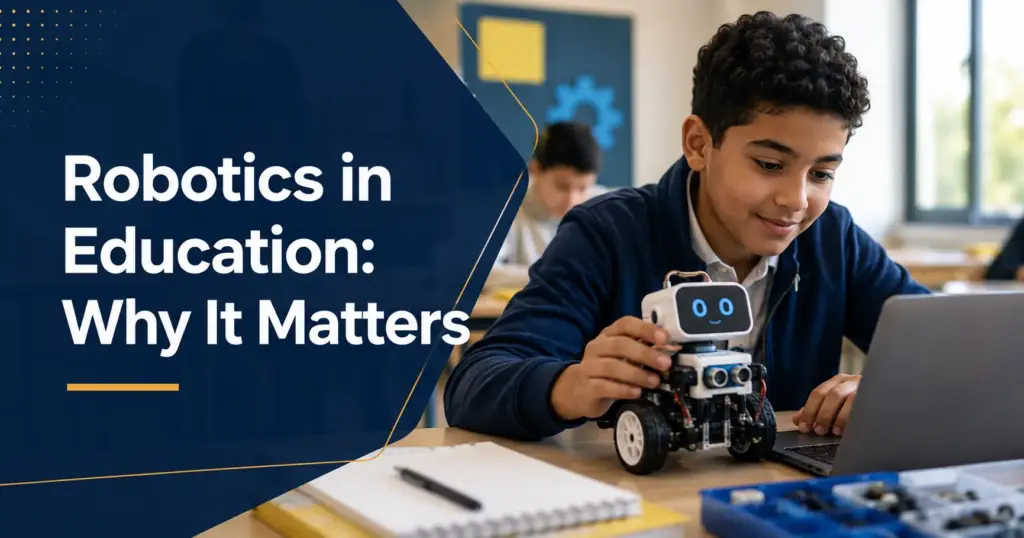
Robotics Education and Its Importance in the Educational Process
The educational process has changed significantly in recent years, with many new subjects being introduced. One of the most notable is Robotics, an engaging and exciting subject for children.
However, many people are still unfamiliar with robotics education or do not fully understand its importance within the educational process. In this article, we will explore robotics education and its role in modern learning.
What Is Robotics Education?
Robotics is an engaging educational field that is becoming increasingly important for preparing children for a more technologically advanced future. Imagine your child designing and building their own robot!
Robotics education includes a variety of learning activities through which students can design, build, assemble, and program robots.
This is achieved using programming and modern technologies. Robots are intelligent machines capable of performing specific tasks accurately and efficiently, and they can also be integrated into educational environments.
Robotics combines several interconnected disciplines, including engineering, computer science, mathematics, and programming. It is not limited to building robots; children also learn programming, develop technological solutions, and discover how technology can be applied to everyday life.
How Can Robotics Be Used in Education?
Robotics can play an important role in supporting the educational process by allowing students and educators to design and develop technologies that facilitate teaching and make learning more engaging and effective.
Robots have entered many areas of modern life, including education. As technology continues to develop, we may increasingly see robots assisting teachers in classrooms.
Robotics can also be used for language learning, helping students improve their listening, pronunciation, writing, and reading skills through interactive programs and activities.
Read also: Smart Applications: Build Your Wealth – International Digital Academy
What Makes Robotics Different from Traditional Subjects?
Robotics is an engaging and exciting subject because it emphasizes hands-on practice and interactive experimentation. Traditional subjects such as mathematics can sometimes be perceived as more theoretical, while robotics allows students to apply concepts in real-world projects.
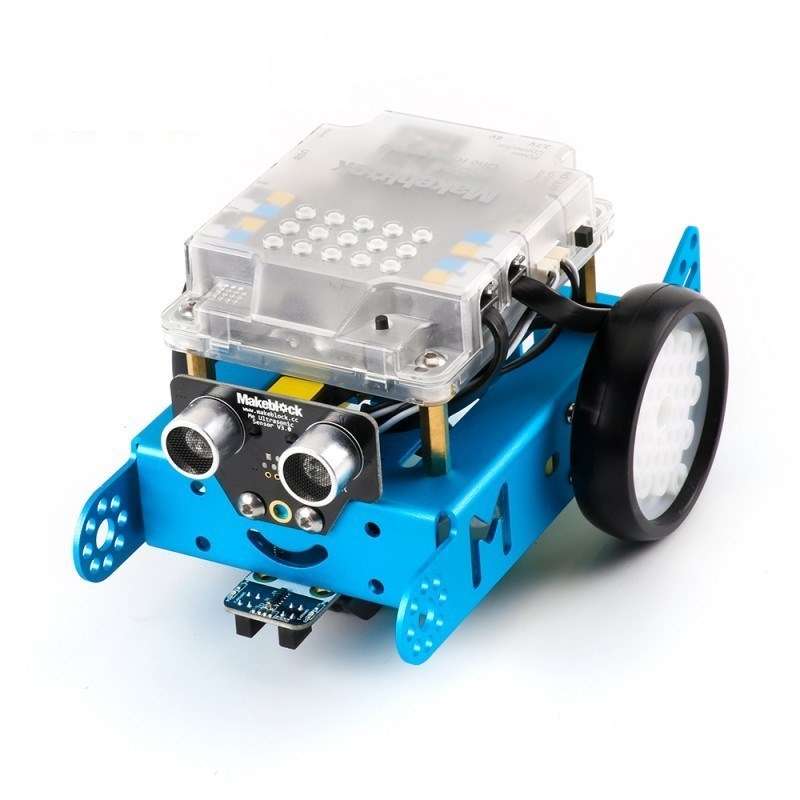
Through robotics, students can disassemble and reassemble robots, learn how to program them to perform different tasks, and understand how to control, modify, and adapt robots according to specific requirements.
While some traditional learning approaches rely heavily on repetition and listening, robotics encourages students to discover something new through experimentation and innovation.
It also develops their programming and technology skills, which are increasingly important in today’s digital world.
What Is the Importance of Robotics in Education?
Modern technology has a significant influence on children’s lives and development. Rather than simply allowing children to consume technology, education can transform technology into a tool for learning, creativity, innovation, and problem-solving.
For this reason, many educational systems have introduced robotics into their curricula to integrate technology into education.
The educational benefits of robotics include:
- Encouraging curiosity and a passion for learning by motivating students to research, experiment, and innovate.
- Developing teamwork and collaborative learning, particularly during design and construction projects, where students can take on different roles such as programmer, designer, researcher, or team leader.
- Encouraging discovery and exploration, especially when students assemble and experiment with different components.
- Developing practical and hands-on skills.
- Strengthening higher-order thinking skills, including creative thinking, critical thinking, and problem-solving.
- Helping students develop organizational and time-management skills.
- Integrating multiple disciplines, including engineering, mathematics, programming, and technology, into a single learning experience.
There are also specialized programs designed to teach robotics to children in the classroom through structured curricula adapted to their educational level, such as the Arduino platform.
Conclusion
Education must keep pace with modern technological developments—not merely by teaching students how to use technology, but also by empowering them to create, develop, and innovate with technology.
This is why integrating robotics education into modern learning environments is so important. It can help prepare a generation that is more creative, innovative, collaborative, and capable of solving the challenges of the future.

Leave a Reply