
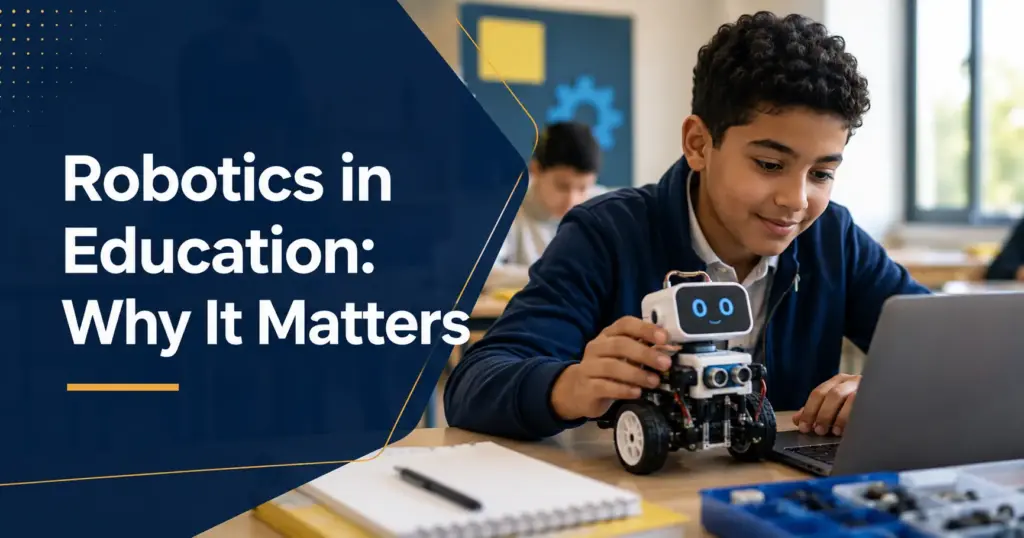
Robotics in Education: Benefits, Skills, and Classroom Uses
Robotics in education combines physical construction, programming, problem-solving, and teamwork in a form that allows learners to test ideas and see immediate results. When activities are tied to clear learning goals, robotics can make abstract concepts more concrete and support active learning.
The educational value does not come from the robot itself. It comes from the questions, tasks, reflection, and feedback built around the activity.
What is educational robotics?
Educational robotics uses programmable devices, kits, sensors, motors, or simulations to help learners design, build, test, and improve a solution. Depending on age and context, activities can range from simple sequencing and movement to programming sensors, collecting data, or solving engineering challenges.
1. Robotics can make problem-solving visible
When a robot does not behave as expected, learners must identify the problem, form a hypothesis, test a change, and observe the result. This creates a natural cycle of debugging and reflection.
Teachers can strengthen the learning by asking learners to explain what they changed and why, rather than focusing only on whether the final device works.
2. It can support collaboration
Robotics projects can be structured so that learners share roles such as planning, building, coding, testing, documenting, and presenting. Rotating these roles helps prevent one learner from controlling the entire task.
Collaboration should be assessed intentionally. Ask learners to explain decisions, document changes, and reflect on how the team solved disagreements.
3. It connects several disciplines
A single robotics task may involve mathematics, measurement, physics, programming, engineering design, language, and presentation. This makes it suitable for interdisciplinary projects when the learning outcomes are clearly defined.
However, avoid adding robotics merely because it is engaging. The activity should still serve the curriculum.
4. It develops computational thinking
Robotics can help learners practice sequencing, decomposition, pattern recognition, logic, iteration, and debugging. Younger learners can begin with simple command sequences, while older learners may use text-based programming or more complex control systems.
5. It can support creativity and design thinking
Open-ended challenges allow learners to create different solutions to the same problem. Teachers can ask them to compare designs, explain trade-offs, and improve a prototype after testing.
How should a teacher plan a robotics activity?
- Define the learning outcome. Decide what concept or skill the activity should develop.
- Choose an age-appropriate tool. Match the hardware or simulation to learner experience.
- Set a clear challenge. Give enough structure to focus learning without prescribing every step.
- Plan roles and time. Decide how teams will share work and how long each phase will take.
- Ask for evidence of thinking. Require notes, code explanations, diagrams, or reflection.
- Assess the process as well as the product. Consider reasoning, collaboration, testing, and improvement.
Common mistakes to avoid
- Choosing technology before defining the learning objective.
- Making one learner responsible for all the coding.
- Assessing only whether the robot works.
- Using equipment that is too complex for the available time.
- Skipping discussion and reflection after the activity.
- Ignoring accessibility, device availability, or learner support needs.
Frequently Asked Questions
What skills can robotics activities develop?
They can support problem-solving, computational thinking, collaboration, design, basic programming, reflection, and communication when those skills are deliberately built into the task.
Does a school need expensive robots to start?
No. Depending on the objective, teachers can use simple kits, low-cost programmable devices, simulations, or shared equipment.
Is robotics only for learners who like coding?
No. Projects can include design, mathematics, documentation, presentation, teamwork, and testing in addition to programming.
How should teachers assess robotics projects?
Assess the learner’s reasoning, collaboration, troubleshooting, explanation, and connection to the learning objective—not only the final product.
At what age can learners start robotics?
Activities can begin early when they are age-appropriate. Younger learners may work with sequencing and simple movement, while older learners can progress toward sensors, electronics, and text-based programming.
Related Reading
For another example of technology-supported teaching, read How Teachers Can Use AI to Save Preparation Time Without Lowering Lesson Quality.
Related IDA Training
Teachers who want to build broader competence in digital tools, interactive resources, and technology-enabled teaching can explore IDA’s Digital Teacher Preparation Course (دورة إعداد المعلم الرقمي). Use the official training needs assessment to request current program details.
Leave a Reply